GHK-Cu
50 mgGHK-Cu is a copper-binding tripeptide studied in skin, collagen and tissue-remodeling research. The meaning of those findings depends on the material, formulation, route and research model.23
 Skip to content

KLOW overview
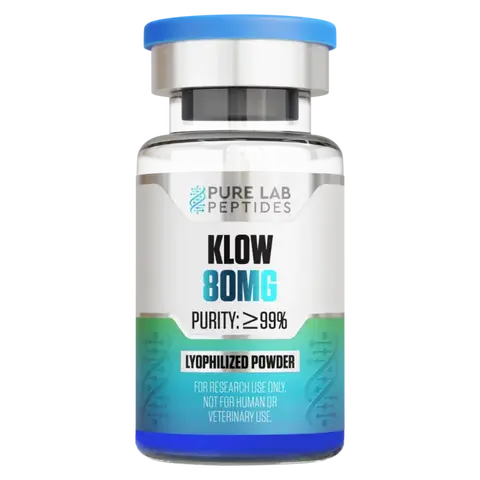
KLOW peptide is the name used for an 80 mg research blend containing GHK-Cu, BPC-157, TB-500 and KPV. This guide explains what is on the label, why the blend draws interest, what published studies say about each ingredient and which questions about benefits and dosage remain open.
The short version
KLOW peptide is a commercial name for a four-component peptide blend, not a single peptide or a standardized scientific term. The product reviewed here lists GHK-Cu 50 mg plus 10 mg each of BPC-157, TB-500 and KPV.8 You may also see it called the KLOW blend or KLOW stack. Because the name is seller-defined, the current label matters; another product could use “KLOW” for a different formula.
That distinction is easy to lose when reading about KLOW online. Most benefit claims trace back to research on one ingredient, such as GHK-Cu or KPV. Those papers can explain where an idea came from, but they do not tell us how the four ingredients behave together.
Explore the ingredientsClaims versus evidence
Interest in KLOW tends to center on recovery, tissue repair, inflammation, skin appearance and gut-related research. The evidence behind those topics is uneven: some ingredients have limited human data in specific settings, while much of the literature comes from cells or animals. None of the cited studies evaluates the exact 80 mg blend.
When a finding sounds promising, look at the material, model and route. A topical study of one ingredient answers a different question from an injection study, an animal experiment or a trial of the finished formula.
Explore KLOW peptide benefitsThe stated 80 mg formula
These figures come from the current product listing, not from dosing research. Treat them as label specifications and recheck them whenever the listing or batch changes.
GHK-Cu is a copper-binding tripeptide studied in skin, collagen and tissue-remodeling research. The meaning of those findings depends on the material, formulation, route and research model.23
Most published BPC-157 research is preclinical. A 2025 systematic review included 35 preclinical studies and one retrospective human study, but found no clinical safety data.4
TB-500 naming is not always consistent. FDA identifies it as the LKKTETQ fragment of thymosin beta-4, and findings for the full 43-amino-acid protein should not be assumed to apply to that fragment.15
KPV is a tripeptide studied in cell systems and mouse models of intestinal inflammation. Those studies did not test KLOW or establish human outcomes.67
Ingredient studies and blend-level gaps
The literature behind KLOW is best understood as four separate evidence trails. GHK-Cu, BPC-157, thymosin-related peptides and KPV have each been studied in different materials, models and routes. We found no published study of the exact 50/10/10/10 mg combination.
A quick comparison of what was studied, why it matters and what remains unanswered about KLOW.Scroll horizontally to compare every column.
| Ingredient | Evidence examined | Research focus | What remains unanswered | Sources |
|---|---|---|---|---|
| GHK-Cu | A broad review and a randomized topical study of 13 people after laser resurfacing. | Collagen synthesis, tissue remodeling, cell signaling and topical recovery outcomes. | Effects of GHK-Cu in this formula, or the complete blend’s safety or effectiveness. | 2 3 |
| BPC-157 | A 2025 systematic review covering 35 preclinical reports and one small retrospective human study. | Musculoskeletal injury and repair models. | Human efficacy, clinical safety or an effect from the finished four-part blend. | 4 |
| TB-500 | Laboratory research relating shorter sequences to activities associated with full-length thymosin beta-4. | Cell migration, survival and repair-related mechanisms. | That findings for the full protein apply to the listed fragment or to KLOW as a product. | 5 |
| KPV | Cell experiments and two mouse models of intestinal inflammation. | Peptide transport and inflammatory signaling in experimental colitis. | Human outcomes, human exposure safety or an effect from the complete blend. | 6 7 |
| Complete blend | The cited seller label; no blend-level study was identified among the sources reviewed. | The stated four-ingredient formula and the claims attached to it. | Safety, effectiveness, ingredient interactions or a human protocol. | 8 10 |
Reddit threads and before-and-after photos can be useful for finding common questions and reported experiences. They cannot confirm the product, exposure, other changes, photo conditions or what caused a result. FTC guidance is clear that testimonials are not a substitute for scientific evidence.10
KLOW vs GLOW peptide
At the label level, KLOW and GLOW share GHK-Cu, BPC-157 and TB-500. KLOW adds 10 mg of KPV, which raises the stated total from 70 mg to 80 mg.89 The formula comparison is straightforward; an outcome comparison is not. The labels do not show that one blend works better or is safer.
Read the full KLOW vs GLOW comparison
The label-level difference: the cited KLOW formula adds 10 mg KPV.
These commercial links lead to the research-use listings used for the formula comparison. Seller pages document what is claimed on the label; they do not independently verify identity, purity, safety or effectiveness.
Understanding the label
The 80 mg figure is the total amount the label says is in the vial. It is not an amount per use, a schedule or a preparation method.
Studies of separate ingredients cannot be combined into a validated KLOW peptide dosing schedule. FDA also reports limited safety information for several listed components and says it has not identified human exposure data for KPV or the TB-500 fragment.1
Understand KLOW amounts and unitsResearch purchasing and quality checks
When evaluating where to buy KLOW peptide for laboratory research, start with the records rather than the headline purity percentage. The product name, four ingredients and lot number should match across the listing, vial and COA. Check who performed the testing, when it was run and which methods were used. FDA’s supplier guidance is written for pharmaceutical compounders, not research-product retailers, but its emphasis on supplier knowledge and valid certificates is a useful quality-control principle.11
A COA is only as useful as the information it contains. Look for the laboratory, analytes, methods, acceptance criteria, units, test date and a matching lot number. One purity percentage does not prove identity, clinical safety or effectiveness.
The current listing also deserves clarification on TB-500 identity. FDA identifies TB-500 as the LKKTETQ fragment, while the seller page displays a different sequence alongside an approximate molecular weight associated with full-length thymosin beta-4.18 Before relying on that specification, request a batch record showing which material was actually tested.
Explore by article
References
Citations appear beside the statements they support. FDA and FTC pages provide regulatory and advertising context, journal articles cover ingredient-level research, and seller pages are used only for current label and listing details.
Evidence and product details last reviewed September 7, 2026. Listings, batch records and regulatory pages can change, so they are rechecked whenever this guide receives a substantive update.